
End-of-Cycle Torsion Springs
The most common call is a torsion spring that's reached the end of its cycle count, usually on a double door since those carry the heaviest spring load and show wear first.
Local garage door service · Durham, NC
Garage door repair and installation for Durham, NC homes, covering torsion springs, cable repair, opener installation, and off-track roller fixes.

Garage door services
From emergency repair and cable repair to opener installation, off-track repair, maintenance, new door installation, and general garage door service, the lineup is built around Durham's 1967-2006 housing stock and the 1980s-90s torsion hardware and steel tracks that came standard across it.


Common Durham garage door problems
Given the 1967-2006 build window, the most common call is a torsion spring that's reached the end of its cycle count - usually on a double door, since those carry the heaviest spring load and show wear first. Close behind that is worn rollers on the original steel track, which get noisy and start binding years before anyone thinks to replace them. Openers from the 80s and 90s builder-grade installs are the other recurring job: the gear kits wear down to plastic dust eventually, and once that happens the motor runs but the door doesn't move, or moves and reverses for no clear reason. Durham sits in a cold-moderate climate band, so winter cold snaps are real enough to make old grease stiffen up and springs that were already marginal finally let go on a cold morning. It's not hurricane country, so we don't see a lot of flood or wind damage calls here - it's mostly age and cycle count doing the work.
The most common call is a torsion spring that's reached the end of its cycle count, usually on a double door since those carry the heaviest spring load and show wear first.
Worn rollers on the original steel track get noisy and start binding years before anyone thinks to replace them, often first noticed as the door moves rough on the way up.
Builder-grade openers from the 80s and 90s wear their gear kits down to plastic dust; the motor runs but can't transfer force, so the door doesn't move or reverses for no clear reason.
A January cold stretch makes old grease stiffen up and springs that were already marginal finally let go on a cold morning, turning a slightly worn spring into a broken one.
With little flood or wind damage in this area, most of what breaks comes down to age and cycle count on hardware that's often never been fully replaced since the house was built.
Clear repair guidance
We don't quote a flat number on the website because door size, spring count, and whether the opener needs replacing all change the bill, and guessing at a price before we've seen the door does nobody favors. What we can tell you is what drives cost here specifically.
Double-door torsion springs cost more than single-door springs because they're heavier and there are two of them, and an opener replacement costs more than a gear kit repair but lasts longer if the unit's old enough that parts are getting scarce.
Median household income across the service area runs $77,799, which is middle-of-the-road for this kind of repair work - most of our calls are people fixing what's broken rather than upgrading for the sake of it, and we price the job to match that, not to upsell a new door when a spring and a service call will do.
The honest trade-off: if your opener is original to a 1980s or 90s build and the gear kit's gone, sometimes a new opener costs close to what a repair would, and lasts a decade longer. We'll lay out both numbers and let you pick.
Local housing matters

Durham's housing is mostly 1980s and 90s stock spread across seven named areas, which means a lot of double doors on steel tracks that were standard builder-grade for that time. If your house was built anywhere near the 1991 median, there's a decent chance your door hardware has never been fully replaced - just patched, re-lubed, maybe one spring swapped after it broke.
That matters because builder-grade torsion springs from that era were sized for the door weight at install, not for twenty-plus years of fatigue cycling. When one side gives out, the other side is usually close behind, which is why we always check both even when you only called about one.
Homes on the older end of the 1967 start of that range sometimes still have the original heavier wood-composite doors, which run harder on the opener and the cables than the lighter steel doors that came standard by the 90s. If your door feels like it's fighting the opener on the way up, that's often the reason, not necessarily a dying motor.
Cold-weather garage door wear
Durham sits in a cold-moderate climate band, so winter cold snaps are real enough to make old grease stiffen up and springs that were already marginal finally let go on a cold morning. It's not hurricane country, so most of what we see is age and cycle count showing up when the cold adds the last bit of stress.
Durham sits in a cold-moderate climate band. Winter cold snaps aren't severe, but a January cold stretch is enough to push already-worn hardware over the edge on homes built across the 1967-2006 range.
Cold mornings make old grease stiffen up, so a door that was moving fine in warmer weather suddenly binds and fights the opener as the hardware works harder against the resistance.
Springs that were already marginal finally let go on a cold morning. A January cold stretch is often what turns a slightly worn builder-grade spring into a broken one.
We don't see a lot of flood or wind damage calls here - it's not hurricane country. The real work is age and cycle count on older torsion hardware, not weather catastrophe.
What to expect
You tell us the symptom and what kind of house you're in, because that actually matters here; we ask about the door and the opener, quote the job on the phone when we can tell what's broken, and tell you straight when we can only know once the door's open.
You tell us what the door is doing - won't open, spring snapped, opener clicking but not moving the door - and we give you a window for the same day or next depending on the schedule.
We ask what kind of house you're in, because most homes here went up between 1967 and 2006 with a 1991 median, so you're dealing with torsion hardware from the Reagan and Clinton years - that narrows what's likely wrong before a truck even leaves.
We ask the door size, single or double, and whether the opener is original or a replacement somebody bolted on later. A lot of these homes still carry their first or second opener, so the gears are worn even if nobody's touched the springs. We quote on the phone when we can tell what's broken.
We tell you straight when we can't quote blind - some things you only know once the door's open and the spring's off the shaft. The number is agreed before we start the work, not after.
Discontinued Opener Boards May Mean a New Unit
One limitation worth saying up front: if your opener model is old enough that the control board is discontinued, we may need to replace the unit rather than chase a part that no longer ships. We'll tell you that before we start, not after.
Repair or replace?
A broken spring, cable, roller, or opener gear kit doesn't automatically mean the whole garage door needs replacing. Replacement becomes the better value when the opener is old enough that parts are scarce, or when a new unit costs close to the repair and lasts far longer.
A targeted repair makes sense when the door, tracks, and surrounding hardware remain serviceable and one component - a spring, a roller, a gear kit - is the actual failure. Most of our calls are fixing what's broken, not upgrading.
A 1980s or 90s builder-grade door can stay worth keeping when its structure is sound and the immediate failure is isolated. A spring and a service call often does it, with no need for a new door.
If your opener is original to a 1980s or 90s build and the gear kit's gone, sometimes a new opener costs close to what a repair would and lasts a decade longer. We lay out both numbers and let you pick.
When an opener's control board is discontinued or parts no longer ship, replacement can beat chasing hardware that's genuinely scarce, so we say so plainly instead of running up a repair bill.
1960s–2000s garage door systems
Durham's 1967-2006 build range means garages can combine double doors on builder-grade steel tracks, torsion springs sized only for their install weight, heavier wood-composite doors on the older end, and openers that are still on their first or second unit.
A lot of 1980s and 90s homes have double doors on steel tracks that were standard builder-grade for that time, and those doors carry the heaviest spring load and show wear first.
Torsion springs from that era were sized for the door weight at install, not twenty-plus years of fatigue cycling. When one side gives out, the other side is usually close behind.
Homes on the older end near the 1967 start of the range sometimes still have the original heavier wood-composite doors, which run harder on the opener and cables than the lighter steel doors standard by the 90s.
A lot of these homes still carry their first or second opener, which means the gears are worn thin even if nobody's touched the springs - age shows in the gear kit before the motor.
Built around Durham garage doors
With double doors, builder-grade torsion springs, heavier older wood-composite doors, and openers swapped at different times across the 1967-2006 range, the door, spring system, opener, and tracks may all be at different points in their life - so we inspect before matching parts.
Because builder-grade springs were sized for install weight and one side usually fails close behind the other, we check both springs even when you only called about one.
A lot of homes still run their first or second opener, so the gear kit may be worn thin even when the springs look fine; we factor the opener's age into what the door actually needs.
If the door, tracks, and supporting hardware remain sound and one component is the actual failure, a full replacement isn't automatically necessary - a targeted repair holds up fine.
When an opener's control board is discontinued or parts are getting scarce, we say so up front and lay out the real repair-versus-replace comparison before you decide.
Service areas
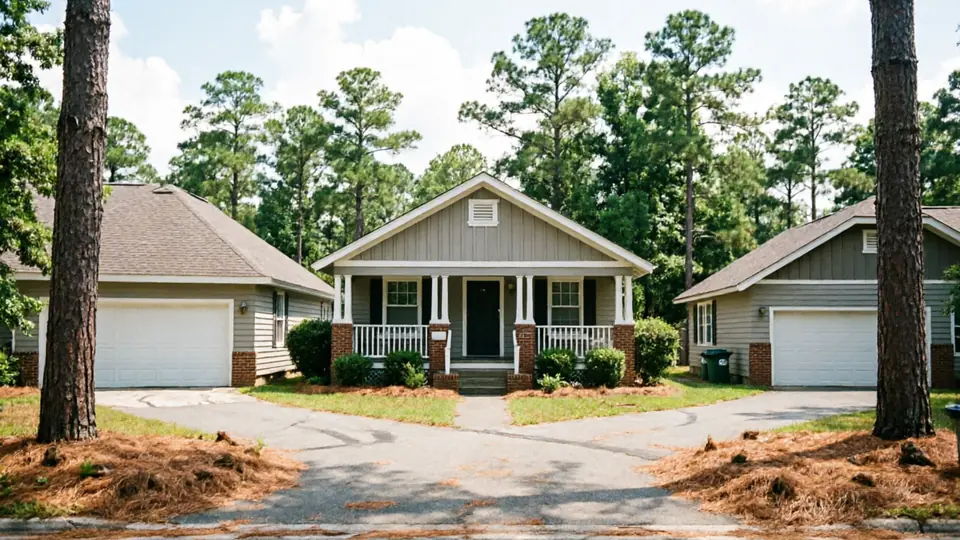
We work close in and we work the ring around the city. Close in: Downtown is about a mile north, East Durham a mile to the ENE, Duke Forest two miles west, Hope Valley three miles southwest, and Old West Durham and Watts Hospital-Hillandale both about three miles NNW. A little farther, the Interstate 85 corridor and Stadium Heights sit four miles north, North Garrett Road four miles west, Croasdaile Farm five miles NNW, Research Triangle Park six miles SSE, Parkwood six miles south, Northeast Durham and Latta Road seven miles out, and Brier Creek Country Club seven miles SE.
Further out we still take calls in Gorman at seven miles, Morrisville at ten, Carrboro at eleven, Hillsborough at thirteen, Butner at fourteen, Creedmoor at sixteen, and Efland at seventeen. If you're past that, call and ask - some days the answer is yes and some days it isn't worth the drive time for either of us. Across this whole footprint there are roughly 30,655 households and about 9,094 owner-occupied houses, which is the real base we pull repair calls from, not just the zip codes near the shop.
From our Durham, NC base we run trucks across the surrounding towns rather than keeping a storefront in each one. These are the areas we serve most often - pick yours to see the local detail.
Questions
If your house was built anywhere in the 1967-2006 range common across Durham, and the springs or cables have never been replaced, you're past the point where we'd call it low risk. Torsion springs are rated for a cycle count, not a calendar date, but houses from the 80s and 90s median era are typically due.
Yes, both are in our coverage area - RTP is about six miles SSE and Northeast Durham about seven miles out. We take calls across the full footprint, from Downtown a mile north out to Efland at seventeen miles, so call and tell us where you are.
On builder-grade openers from the 80s and 90s, which are common in this housing stock, that's almost always the internal gear kit worn down to plastic dust. The motor spins but can't transfer force to the door. It's a repairable part, not usually a sign you need a whole new opener.
No. Torsion springs are under enough tension to cause a serious injury if released wrong, and the tools for it aren't something most garages have lying around. It's one of the few jobs where we'd say don't try it yourself, even if you're handy with everything else.
Ready when you are
Tell us what the door is doing and we'll help you pin down the problem in Durham.